From Denver to Melbourne, two families touched by pediatric brain cancer became united by their belief in the power of research—and the understanding that waiting for progress is not an option.
pGBMs are a rare, aggressive, Grade IV brain tumor with very low survival rates. “My father was an adult neurosurgeon and luckily found that one of the 23 pediatric oncologists worldwide was in Denver, Colorado—Dr. Nick Foreman. This was before smartphones and abundant internet resources. We were lucky,” she added.
But that luck was short-lived. “Even though Morgan presented emergently with her tumor, she initially overcame it. By July of 1998, we thought she’d be in the 10% survivors,” Joan said. “But by August, she’d relapsed. Her tumor had gotten so big that the doctors told us nothing more could be done.” In December of that year, Joan and Steven said goodbye to Morgan.
After her death, Morgan’s parents grieved—and got to work. In 1999, Joan and Steven joined the Pediatric Oncology Board at Children’s Hospital Colorado and became involved in its bench science program. By 2000, the couple had committed all of their philanthropy and efforts to funding promising early-stage research ideas. “Steven didn’t want to sit and talk,” Joan said. “He wanted us to do something.”
Since 2001, The Morgan Adams Foundation has funded nearly $15 million in pediatric cancer research, supporting the most promising pilot, seed, and translational studies across the globe aimed at developing better therapies for children with cancer.
A Shared Mission
Nearly two decades later, across the world, another family facing pediatric brain cancer would arrive at a strikingly similar decision: waiting for progress was not enough.
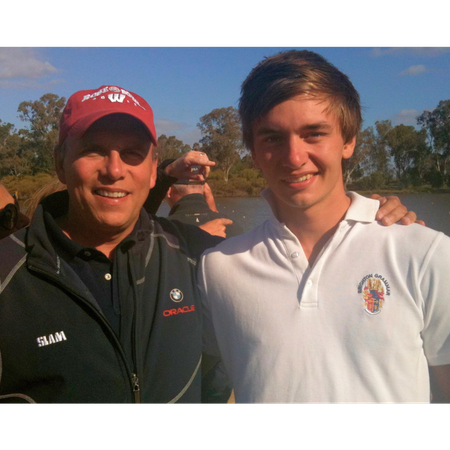
Born in Wisconsin, Robert Connor Dawes, “Connor”, moved with his family to Australia’s sunny bayside suburbs in Victoria when he was young. A bright high school student who enjoyed rowing, music, and Latin, Connor had the world at his feet until brain cancer had other plans.
“Connor had an ependymoma brain tumor,” said Dr. Kim Wark, Head of Research at the Robert Connor Dawes (RCD) Foundation.
As Kim explained, pediatric brain cancers are biologically distinct from adult cancers, yet treatments have often been adapted from adult therapies rather than designed specifically for children. “Even though Connor was 18 years old when he passed, his was a pediatric brain tumor. This makes it challenging for patients like Connor, who may fall between the cracks transitioning from pediatric to adult health services but also access to clinical trials,” she continued.
Throughout his cancer battle, Connor’s heart was with the younger patients receiving care. “He couldn’t bear to see the young children going through this and wanted to help them,” shared Kim. “‘Mom,’ he said, ‘I can endure this at 17, but they’re so little. You can’t quit.’ Liz Dawes took up his challenge and established the Robert Connor Dawes Foundation in his memory, with a vision that, through our leadership, we will enable every pediatric brain cancer patient to receive the best global treatment available,” Kim continued.
Connor’s initials not only represent the foundation’s name but also its work: Research, Care, and Development. Dr. Kim Wark helps ensure this focus guides the foundation’s decisions and investments. Today, the RCD Foundation supports pediatric brain cancer research and collaborative clinical initiatives across Australia, the United States, and globally.
Though headquartered in Melbourne, Australia, the RCD Foundation is also a registered charity in the United States and maintains strong connections across both countries. Over time, RCD developed a collaborative research and funding model to advance promising pediatric brain cancer therapies alongside trusted scientific and clinical partners. The organization now works across borders with researchers, clinicians, and philanthropic groups who understand that pediatric brain cancer is too complex to solve alone.
Accelerating New Therapies
That collaborative philosophy ultimately helped bring The Morgan Adams Foundation, RCD Foundation, and COG together in support of ACNS2422, an upcoming clinical trial focused on children with ependymoma—the kind of tumor Connor had.
When Dr. Foreman, the clinician who helped care for Morgan, initially requested funding from The Morgan Adams Foundation, he shared a significant challenge: the cost per dose of the drug being tested was $40k. “It couldn’t go forward because there was no mechanism to pay for the drug,” said Joan. “Nick asked if we could get a coalition to back it,” she said. COG needed an answer quickly. The trial’s total cost would be around $1.5M—the majority of The Morgan Adams Foundation’s annual budget.
“The Morgan Adams Foundation reached out to request co-funding,” shared Kim. “We believed in the science, the investigators, and the trusted co-funders. We were confident this was an important investment with potential for real impact.” Together, the organizations helped remove the barriers preventing the trial from moving forward.
“Someone has to step forward and say, ‘We have to make sure this work will continue,’” said Joan. “The COG study team got a generic version of the drug approved, lowering the total trial price and helping make the upcoming study financially viable.”
In many ways, the partnership reflected the same collaborative model that drives pediatric cancer research: researchers, clinicians, and philanthropic organizations working across institutions and borders toward a singular goal. “Even back then, we knew no single institution could be solely responsible for advancing cures in all cancers,” said Joan.
At the heart of both foundations’ work is a common goal: helping children not only survive cancer but live healthier lives beyond treatment. “We want cures, but cures with the least possible amount of damage,” Joan said.
Advancing Promising Science
For both foundations, ACNS2422 represents something larger than a single clinical trial: a broader commitment to advancing pediatric brain cancer research through collaboration, early-stage investment, and collective expertise.
“Collaboration is a crucial component of moving results forward in these rare disease spaces, and it’s important that we leave our ego at the door. It’s not about who gets the win. We’re here to save lives,” Joan said.
Both foundations emphasized the critical role philanthropy plays in supporting early-stage discovery. This work helps scientists better understand how cancers form, spread, and respond to treatment before therapies ever reach clinical trials.
Joan understands that urgency personally. “There were no options for Morgan,” she said. “If people are not trying new things, we can’t figure out what might work.” But promising research only becomes viable treatment through both philanthropic investment and strong scientific partnership. Organizations like COG help foundations identify, evaluate, and advance research with the strongest potential to improve outcomes for children.
“COG provides a level of confidence, the infrastructure, and knowledge that individual foundations don’t have, nor is it our role,” said Kim. “Groups like COG provide that base of expertise and resources to actually make it work.”
At RCD, collaborative funding enables the foundation to invest in more trials overall and to support trial evaluation and due diligence. “It’s an efficient and effective way to invest—everyone wins,” Kim added.
More Than Hope
Joan emphasized that many advances in pediatric cancer research have been driven by philanthropic organizations willing to fund early-stage ideas that larger systems are not ready or able to invest in. As she put it, “Much of the progress in pediatric cancer has been made on the back of the private sector.”
Continued investment in early-stage innovation remains critical—not only to advancing new therapies, but to ensuring promising science reaches children who urgently need better options. “While progress for tumors like Morgan’s remains challenging, there have been breakthroughs in other areas of pediatric cancer,” said Joan. “None of it would have happened if people weren’t willing to fund an idea in the lab to see where it might go,” she continued.
“I would love to know who my daughter would be at 33,” Joan said. “Research is hope in action. More than hope, let’s move it forward.”