
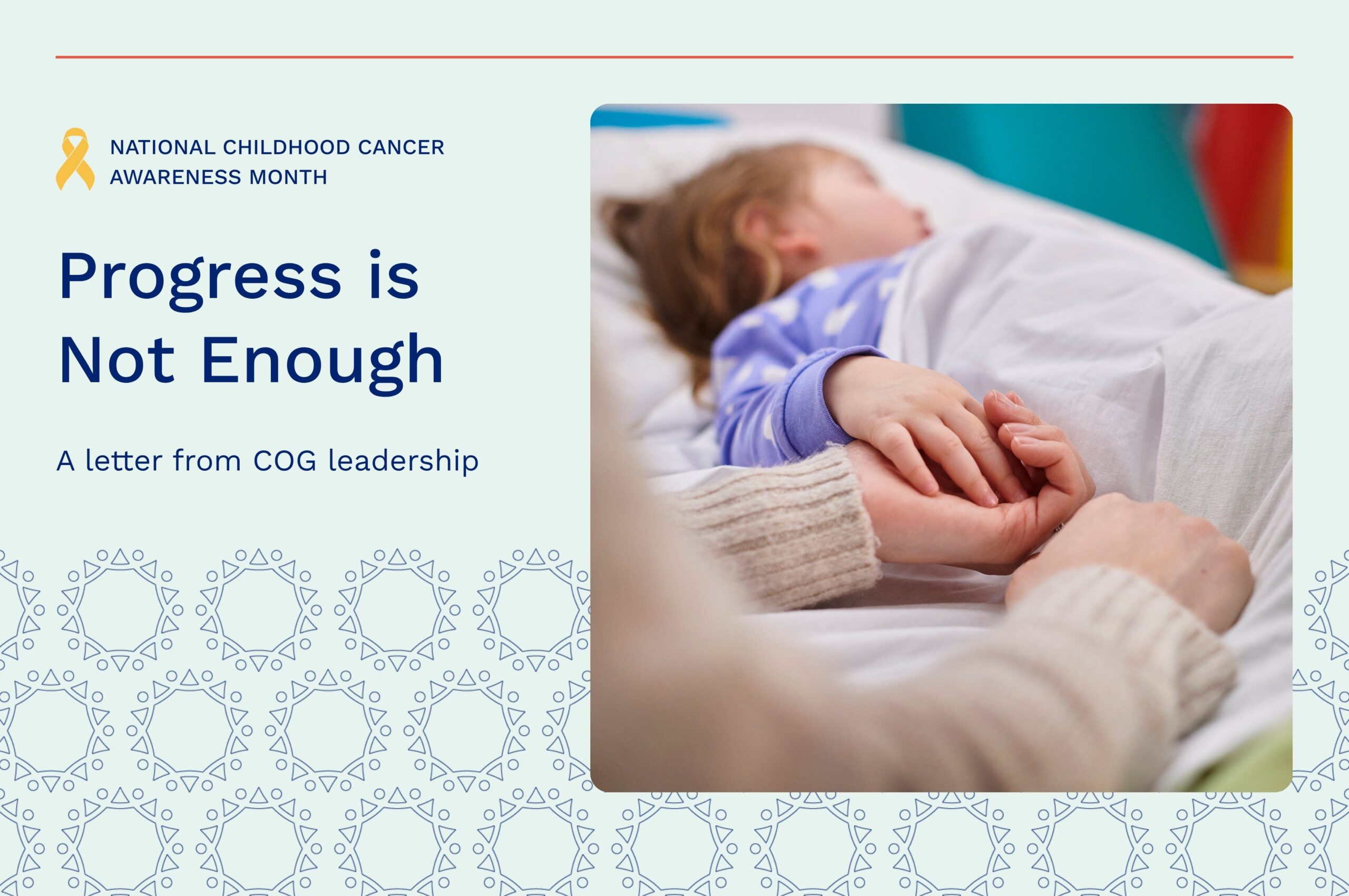
Progress Is Not Enough.
Each September, National Childhood Cancer Awareness Month gives us an opportunity to reflect on how far childhood cancer research has come.
There is real progress to celebrate.
More children survive cancer today than ever before. Treatments that once seemed impossible are now standards of care. Researchers have learned how to cure some cancers with less treatment, reducing the burden on children and the long-term effects they may carry with them. New therapies continue to create possibilities for children whose cancers once had few options.
These advances matter enormously. But that progress is not enough.
We hear from bereaved families. We hear from survivors living with the lasting effects of treatment. We hear from parents and caregivers still in the fog of diagnosis, treatment, relapse, and recovery.
Because while more children are surviving cancer, children are still dying from it. There are still cancers for which outcomes remain unacceptably poor. There are still children who initially respond to treatment only to have their cancer return. And there are survivors who will live for decades with serious health consequences from the treatments that saved their lives.
We have come a long way, and we have much further to go.
What Progress Really Looks Like
Progress in childhood cancer research does not always arrive as a dramatic breakthrough.
Sometimes it is a new treatment for a small group of children who previously had few options. Sometimes it is one less cycle of chemotherapy. A lower dose of radiation. A treatment that causes less damage to a child’s heart, hearing, fertility, or developing brain.
The numbers can look small.
For the child whose life is saved, every gain matters, no matter how small.
For those whose future is changed by that advance, numbers that seem small are anything but. That is why progress must continue.
Over generations of research, those advances build upon one another. Questions answered decades ago make it possible to ask better questions today. Treatments are refined. New approaches are tested. Researchers learn not only how to help more children survive, but how to help them live longer, healthier lives after cancer.
“The driving force behind why research
is so important is that we want to be able
to tell the next child and family we see:
‘We have an answer. We’ve learned something.
We have a better treatment. We don’t know
whether every individual trial will improve
outcomes, but we know we will learn something
that helps us design a better trial for the future.’”
–Douglas S. Hawkins, MD
That is how childhood cancer research moves forward: one question, one study, one finding at a time.
And every advance reveals more of what we still do not know, and shapes how we will do better in the future.
No Simple Path Forward
Earlier this month, we shared what it takes to move a research question from an idea to a finding.
The answer is rarely simple.
Childhood cancers are themselves complex. They do not mirror adult cancers in origin, genetics, or treatment response. Many are rare, which means researchers must collaborate across institutions to enroll enough patients to answer important questions. Studies can take years to develop and conduct. New discoveries lead to new questions. Promising ideas require funding, infrastructure, expertise, participation, and time before we know whether they can improve care.
There is no shortcut around that complexity. But there is tremendous opportunity within it.
Today, researchers have tools and knowledge previous generations could only imagine. We can study the biology of childhood cancer in extraordinary detail. We can identify differences between cancers that once appeared to be the same disease. We can ask increasingly precise questions about which treatments work, for whom, and how we might reduce their long-term consequences.
Research has opened doors we once could not see. And many more remain to be opened.
Until Every Child Has a Future
For those of us who have spent our careers caring for children with cancer and advancing childhood cancer research, progress brings both hope and urgency.
We know what research has made possible because we have seen it.
We have watched treatments change. We have watched children survive cancers that previous generations could not. We have watched new findings become new standards of care.
We have also been with families when treatment did not work. We have delivered the news that there were no other options, or that a cancer had returned.
“I don’t think any of us will
be happy until every kid survives,
and even more until every kid thrives
and has a wonderful life ahead of them.
That’s what drives us. That’s what keeps pushing us.
And until we can make that possible, our work isn’t done.”
– Lia Gore, MD
That is why we cannot confuse progress with completion.
Our goal is not simply for more children to survive cancer.
We want every child to survive. And survive well. We want them to live long, healthy lives without carrying the devastating effects of their treatment with them.
We are not there yet.
So as National Childhood Cancer Awareness Month comes to a close, we ask you to carry this awareness forward.
Celebrate progress. Understand what it has taken to achieve it. And recognize how much work remains.
Because every question we answer can open another door. Every finding can create another possibility. And every child deserves the future research can help make possible.
With gratitude,
Douglas S. Hawkins, MD
Group Chair, Children’s Oncology Group
CEO, Children’s Oncology Group Research Foundation
Lia Gore, MD
Vice Chair, Children’s Oncology Group
Chief Strategy Officer, Children’s Oncology Group Research Foundation
Subscribe below to receive updates on groundbreaking research, scientific discoveries, and the lives they impact.